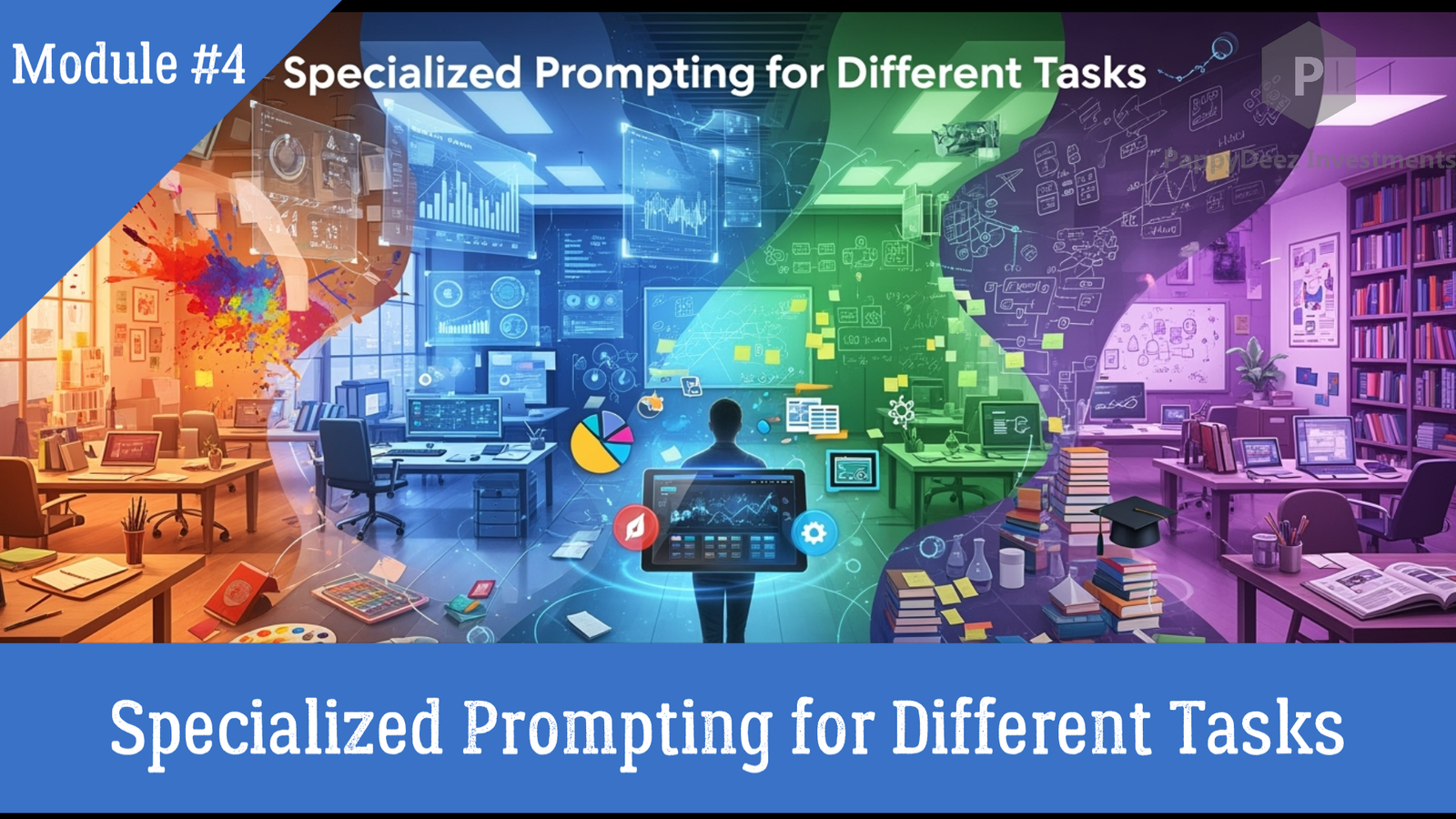
Task-Specific Prompting - Customizing Your Approach for Maximum Results
One Size Doesn't Fit All: Specialized Strategies for Different Types of Work
You wouldn't use the same approach to brief a lawyer and a graphic designer, right? The same principle applies to AI prompting. Different tasks require different strategies, and understanding these nuances can dramatically improve your results.
Today we'll explore the specialized techniques that professionals use for four major categories of AI-assisted work.
Creative Writing: Bringing Ideas to Life
Creative tasks need rich context and sensory details. The AI needs to understand not just what you want, but the feeling and atmosphere you're aiming for.
The Creative Prompting Formula
- Setting and atmosphere (time, place, mood)
- Character details and motivations
- Tone and style references
- Specific elements to include or avoid
- Target audience and reading experience
Example - Creative Brief: "Write a mystery short story (1,000 words) set in a 1940s jazz club during a thunderstorm. Tone: noir with subtle humor. Main character: cynical detective with a secret love of poetry. Include: smoky atmosphere, tension between characters, a clue hidden in song lyrics. Avoid: violence, explicit content. Audience: readers who enjoy classic detective fiction."
Pro tip for creative work: Use emotional and atmospheric words. Instead of "write a story," try "craft a tale that feels like..." or "create a piece that captures the essence of..."
Analytical Work: Getting to the Truth
Analysis requires structure, evidence, and logical progression. Your prompts need to guide the AI through a systematic thinking process.
The Analysis Framework
- Define the question or problem clearly
- Specify data sources or evidence to consider
- Request structured methodology
- Demand explicit reasoning
- Ask for limitations and caveats
Example - Business Analysis: "Analyze the potential ROI of implementing a 4-day work week at our 200-person marketing agency. Structure your analysis with: 1) Cost implications (salary, benefits, overhead), 2) Productivity factors (research findings, industry benchmarks), 3) Talent retention impact, 4) Client service considerations, 5) Risk assessment. Include specific data points where possible and clearly state assumptions."
Problem-Solving: Finding the Best Path Forward
Problem-solving prompts need to guide AI through a structured approach while encouraging creative thinking within practical constraints.
The Problem-Solving Structure
- Define the problem and its impact
- List all relevant constraints
- Request multiple solution approaches
- Ask for pros/cons of each option
- Specify decision criteria
Example - Problem-Solving: "Help solve this scheduling challenge: Our 12-person remote team spans 8 time zones, and we need weekly all-hands meetings where everyone can participate meaningfully. Constraints: No one should meet before 8 AM or after 6 PM their local time; meetings must be under 90 minutes; we need engagement, not just passive listening. Approach: 1) Identify feasible time windows, 2) Propose 3 different meeting structures, 3) For each, explain how to maintain engagement, 4) Recommend your top choice with reasoning."
Learning and Education: Building Understanding
Educational prompts should match your current knowledge level and learning style while providing clear progression paths.
The Learning Framework
- State your current knowledge level explicitly
- Specify learning goals and application context
- Request analogies and real-world examples
- Ask for progressive complexity
- Include comprehension checkpoints
Example - Learning Prompt: "Teach me about blockchain technology. I understand basic computer concepts but have no cryptocurrency or programming background. Structure: 1) Start with a simple analogy, 2) Explain core concepts in plain language, 3) Show a practical use case, 4) Explain one common misconception, 5) Suggest what to learn next. Keep explanations conversational and avoid technical jargon unless you define it first."
Domain-Specific Considerations
For Business Tasks
- Always include relevant metrics and KPIs
- Specify stakeholder perspectives
- Request actionable recommendations
- Ask for implementation timelines
For Technical Work
- Specify programming languages or technologies
- Include version numbers and compatibility requirements
- Request code comments and documentation
- Ask for error handling and edge cases
For Personal Projects
- Be honest about skill level and resources
- Specify time and budget constraints
- Request beginner-friendly explanations
- Ask for common pitfalls to avoid
Your Specialization Challenge
Identify your three most common types of AI-assisted tasks. For each one:
- Write a task-specific prompt template
- Test it on a real project
- Note what worked and what to adjust
- Refine your template based on results
Coming Up Next
Even with great task-specific prompts, things don't always go perfectly. Our next post covers the troubleshooting skills that separate frustrated AI users from successful ones—how to diagnose problems, iterate effectively, and rescue prompts that aren't working.
Task-specific prompting is about speaking the language of the work you're doing. When you match your prompting strategy to your task type, AI stops feeling like a generic tool and starts feeling like a specialist collaborator.