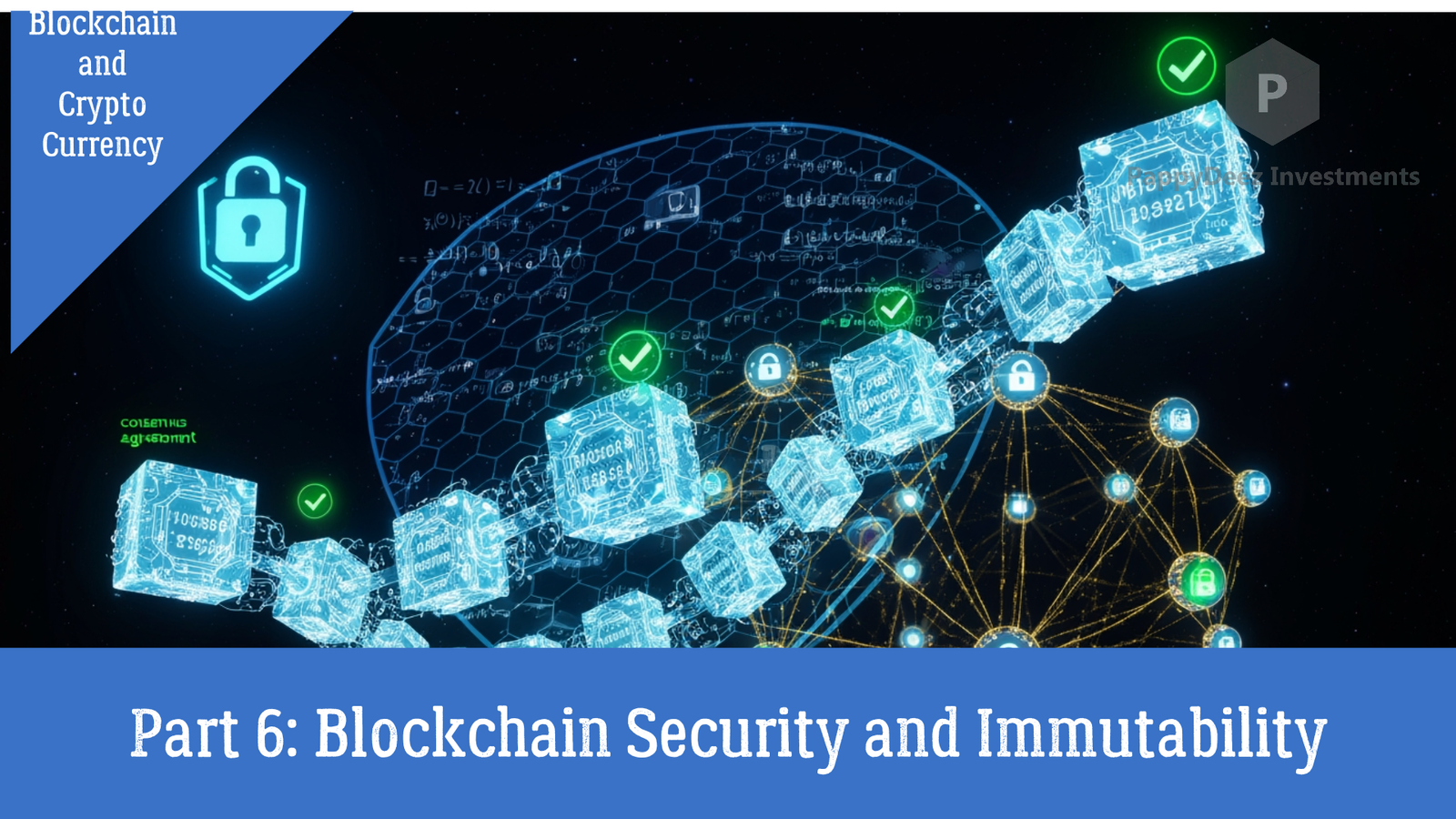
Part 06: Blockchain Security and Immutability
Why Blockchain is Secure
1. Cryptographic Hashing
Each block has a unique "fingerprint" (hash) Change even one character in a block, and the hash completely changes This makes tampering immediately obvious
2. Chain Linkage
Each block contains the hash of the previous block To change one block, you'd need to change every block after it This becomes exponentially harder with each new block
3. Distributed Network
Thousands of computers hold copies of the blockchain To hack it, you'd need to control 51% of these computers simultaneously For major blockchains like Bitcoin, this is practically impossible
4. Consensus Mechanisms
The network must agree on which transactions are valid Different blockchains use different methods (Proof of Work, Proof of Stake) This prevents any single party from controlling the system
Understanding Immutability
Once a transaction is confirmed and added to the blockchain, it cannot be
- Reversed
- Deleted
- Modified
- Hidden
This is both a strength and a potential weakness
Strengths
Prevents fraud and tampering.
Creates a permanent, auditable record.
No one can change history.
Weaknesses
Mistakes can't be undone.
Sent to wrong address? Those funds are gone forever.
No customer service to call for help