Part 08: Important Concepts for Beginners
Gas Fees (Ethereum and Similar Networks)
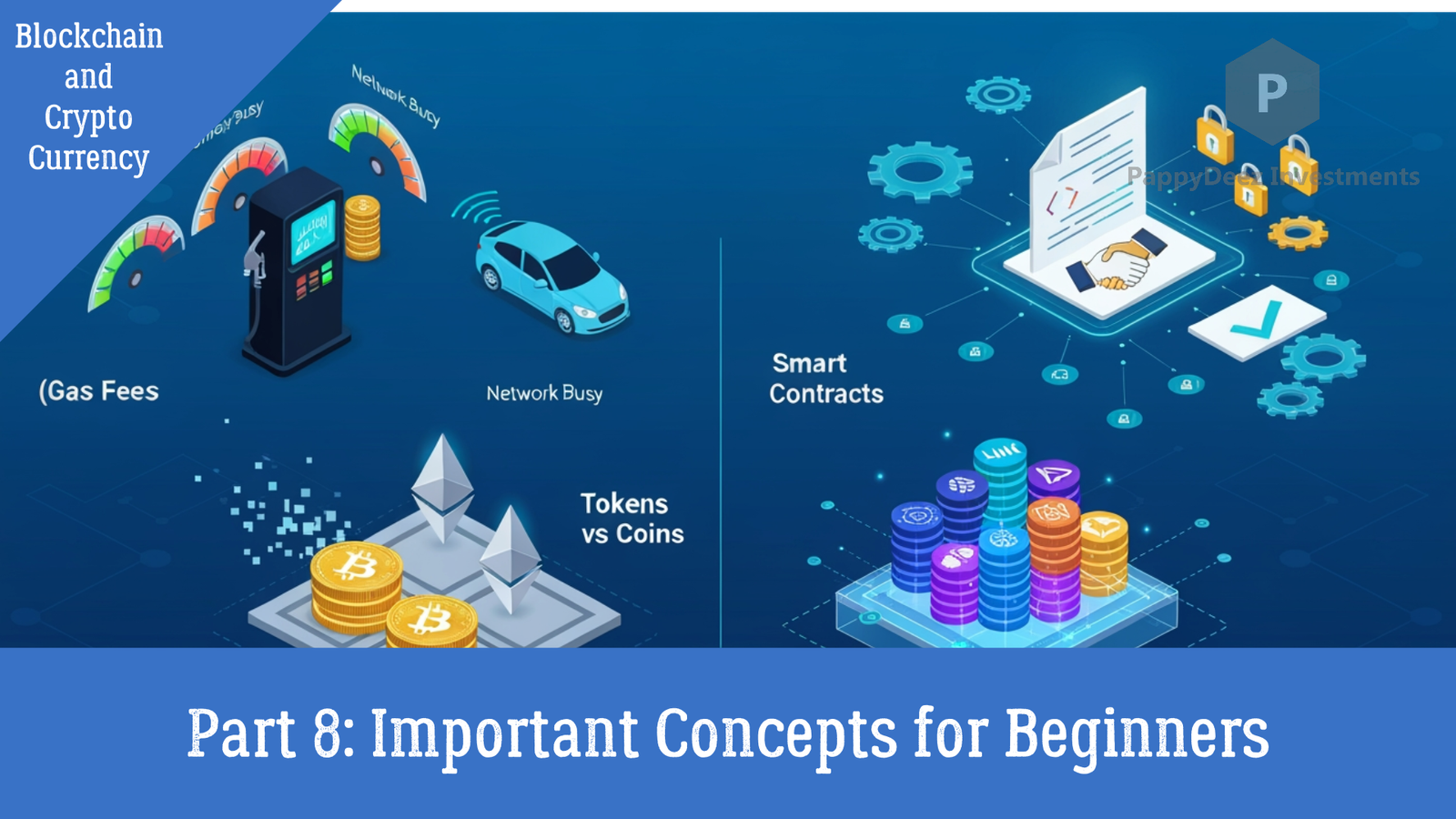
On some blockchains, particularly Ethereum, transaction fees are called "gas fees." Think of gas like fuel for your car:
Simple transactions need less gas. Complex transactions (like interacting with smart contracts) need more gas. When the network is busy, gas prices go up. You can pay more to have your transaction processed faster
Smart Contracts
These are self-executing contracts with the terms written in code
No intermediary needed.
Automatically execute when conditions are met.
Can't be altered once deployed
Example: Escrow services, automated payments, decentralized applications
Tokens vs. Coins
Coins
Have their own blockchain.
Bitcoin on Bitcoin blockchain, Ethereum on Ethereum blockchain.
Primarily used as currency or store of value
Tokens
Built on existing blockchains (most tokens use Ethereum)
Can represent anything: assets, voting rights, access to services
Examples: Chainlink (LINK), Uniswap (UNI)
Decentralized Finance (DeFi)
Financial services built on blockchain technology.
Lending and borrowing without banks.
Trading without traditional exchanges.
Earning interest on cryptocurrency holdings.
All automated through smart contracts
Non-Fungible Tokens (NFTs)
Unique digital assets verified on the blockchain
Each NFT is one-of-a-kind.
Can represent digital art, collectibles, game items, real estate, etc.
Proof of ownership recorded on the blockchain.
Can be bought, sold, and traded.