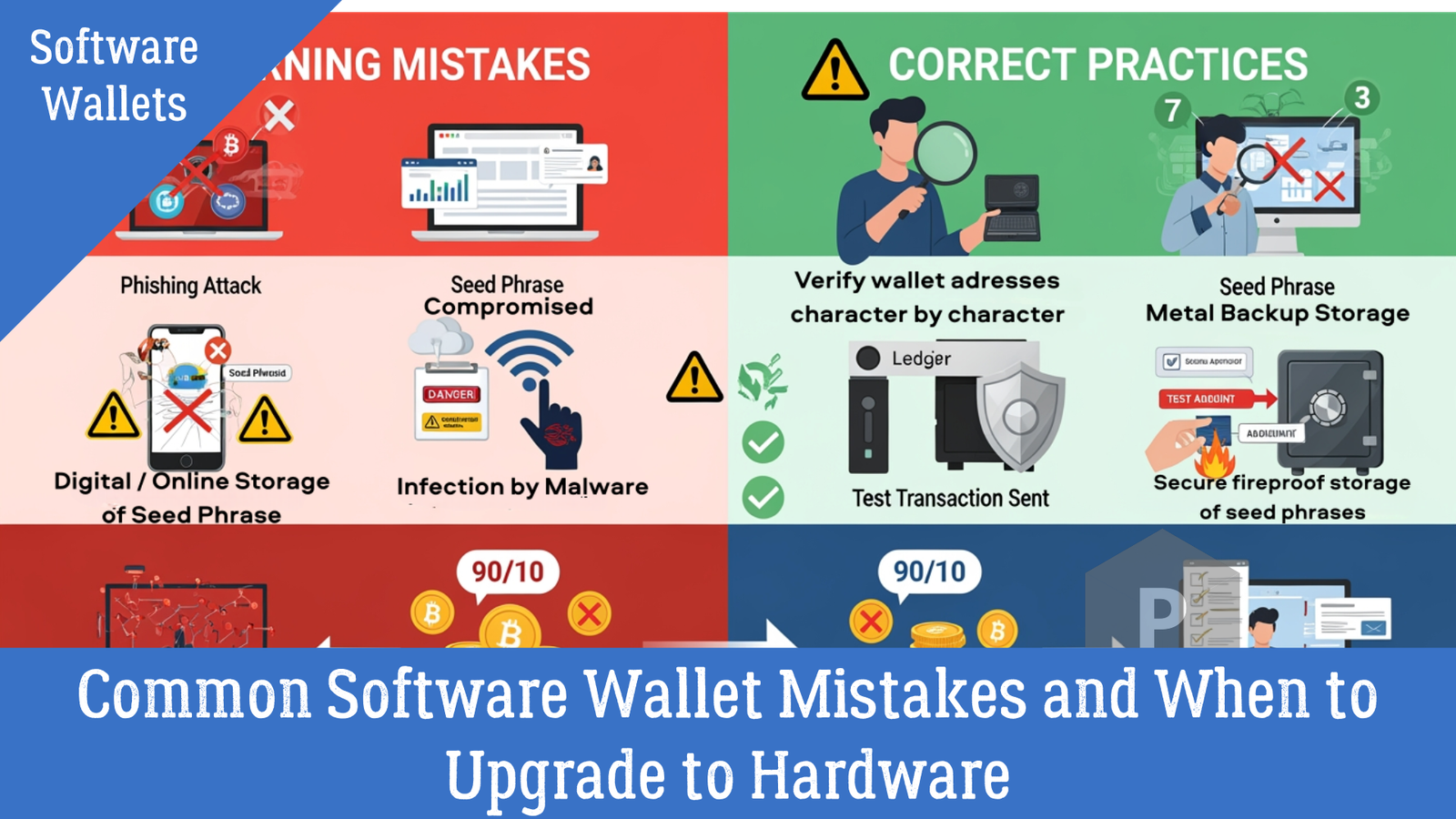
Common Software Wallet Mistakes and When to Upgrade to Hardware
Learning from others' errors and knowing when to level up your security
Everyone makes mistakes when starting with cryptocurrency wallets. The key is learning from others' experiences so you don't have to learn the hard way. In this guide, we'll explore the most common pitfalls, how to troubleshoot typical issues, and when it's time to transition to a hardware wallet.
10 Common Mistakes to Avoid
1. Not Verifying Addresses Before Sending
The Mistake: Copying and pasting an address without checking it, trusting your clipboard blindly.
The Consequence: Malware can replace clipboard contents with an attacker's address. Cryptocurrency sent to the wrong address is permanently lost—there's no customer service to call, no transaction reversal.
How to Avoid: Always verify at least the first and last 4-6 characters of addresses before confirming transactions. Send small test transactions first when dealing with new recipients. Take the extra ten seconds—it could save thousands.
2. Sending to the Wrong Network
The Mistake: Sending USDT on the Ethereum network to an address expecting it on Binance Smart Chain, or vice versa.
The Consequence: Your funds appear to vanish and may be permanently unrecoverable, even though the transaction "succeeded" from your perspective.
How to Avoid: Always confirm the network with the recipient before sending. Double-check your network selection in the wallet before hitting send. When in doubt, ask again.
3. Storing Seed Phrases Digitally
The Mistake: Taking screenshots of your seed phrase, saving it to cloud storage, emailing it to yourself, or storing it in a password manager.
The Consequence: Digital storage is vulnerable to hacking, malware, company data breaches, and cloud account compromises. Your seed phrase in digital form is a ticking time bomb.
How to Avoid: Only store seed phrases on paper or metal, kept in secure physical locations. No exceptions, no matter how convenient digital storage seems.
4. Ignoring Software Updates
The Mistake: Using outdated wallet software or operating systems, dismissing update notifications.
The Consequence: Missing critical security patches leaves you vulnerable to known exploits that attackers actively target.
How to Avoid: Enable automatic updates where possible. Regularly check for wallet updates, downloading only from official sources. Keep your operating system current.
5. Keeping Large Amounts in Hot Wallets
The Mistake: Storing significant holdings—thousands or tens of thousands of dollars—in internet-connected software wallets.
The Consequence: Increased exposure to hacks, malware, phishing attacks, and social engineering. Hot wallets are for spending money, not life savings.
How to Avoid: Use software wallets only for small amounts and daily transactions. Once your holdings exceed your personal risk tolerance (often $1,000-$5,000), move the majority to a hardware wallet.
6. Falling for Phishing Scams
The Mistake: Clicking malicious links in emails or social media, entering seed phrases on fake websites that look legitimate.
The Consequence: Immediate loss of all funds in the compromised wallet. Attackers drain accounts within minutes of obtaining seed phrases.
How to Avoid: Bookmark official sites and only use your bookmarks. Never click links in emails or messages related to your wallet. Always verify URLs character by character. Be suspicious of anyone offering help unsolicited.
7. Not Testing Recovery Before Storing Large Amounts
The Mistake: Assuming your seed phrase backup is correct without actually testing the recovery process.
The Consequence: Discovering your backup doesn't work when you need it most—after a lost phone, broken computer, or corrupted wallet file.
How to Avoid: Practice wallet recovery on a separate device before depositing significant funds. Verify you can successfully restore access using only your seed phrase.
8. Ignoring Token Approvals
The Mistake: Granting unlimited token approvals to every dApp you interact with, never revoking old approvals.
The Consequence: Malicious or compromised smart contracts can drain all approved tokens, even months or years after you last used a platform.
How to Avoid: Regularly audit and revoke unused approvals using tools like Revoke.cash. Only approve specific amounts when the option exists. Research platforms before granting any approvals.
9. Using Public Wi-Fi for Transactions
The Mistake: Accessing wallets or making transactions on unsecured public networks at coffee shops, airports, or hotels.
The Consequence: Man-in-the-middle attacks can intercept passwords, manipulate transaction details, or redirect transactions to attacker-controlled addresses.
How to Avoid: Only access wallets on trusted, private networks. If you must use public Wi-Fi, use a reputable VPN. Better yet, wait until you're on a secure network.
10. Panicking During Market Volatility
The Mistake: Making hasty transactions during FUD (fear, uncertainty, doubt), clicking suspicious "recovery" or "protection" links when stressed.
The Consequence: Poor financial decisions made in panic, falling for scams that specifically target frightened or confused users during market downturns.
How to Avoid: Develop a plan before volatility hits. Take time to verify information during stressful periods. Remember that scammers thrive on urgency and fear.
Troubleshooting Common Issues
Problem: Can't See My Balance
Possible Causes & Solutions:
You might have the wrong network selected. Your USDT might be on Binance Smart Chain, but you're viewing the Ethereum network. Simply switch to the correct network.
The token may not be added to your wallet. Manually add it using the token's contract address from CoinGecko or the official project website.
Your blockchain might not be synced yet. Wait for the wallet to fully sync, close and reopen the application, or check your internet connection.
The transaction might still be pending. Check the transaction status on a blockchain explorer using your transaction hash.
Problem: Transaction Failed
Common Reasons & Solutions:
Insufficient gas fees are the most common culprit. Increase the gas fee and retry the transaction. Always keep native tokens (ETH, BNB, etc.) in your wallet for gas.
For decentralized exchange trades, slippage tolerance might be too low. Start with 0.5% slippage and increase to 1-2% if needed, though be aware higher slippage can result in worse prices.
Smart contract errors occur when the contract itself has issues. Check if the contract is working properly on community forums or social media. Wait and try again later.
Network congestion during busy periods can cause failures. Wait for less congested times or increase gas fees to prioritize your transaction.
Problem: Forgot Password
For non-custodial wallets: If you have your seed phrase, simply restore the wallet on a new device or reinstall the application, then create a new password during recovery. If you don't have your seed phrase, your funds are permanently lost. This is the harsh reality of self-custody—there's no password recovery service.
For custodial wallets: Use the password recovery features provided by the service, contact customer support, and complete any identity verification required.
Problem: Suspicious Transaction Appeared
Immediate Actions:
Don't interact with it. Don't click any links, visit any websites mentioned in transaction notes, or attempt to move unknown tokens.
These are usually dust attacks (tiny amounts sent to track your activity), spam tokens trying to get you to visit malicious websites, or fake airdrop scams.
Simply ignore them completely. Hide them in your wallet if the option exists. Never approve spending permissions for unknown tokens.
Problem: Sent to Wrong Network
The Hard Truth: In most cases, funds sent to the wrong network are permanently lost. This is one of the most painful mistakes in cryptocurrency.
Possible Recovery (Rare): If both chains are EVM-compatible (like Ethereum and Binance Smart Chain) and you control the destination wallet, you might recover funds by importing your wallet to the correct chain. This requires technical knowledge and doesn't always work.
Prevention: Always verify the network before sending. Send small test transactions first. Communicate clearly with the recipient about which network to use.
When to Transition to Hardware Wallets
Signs You Should Upgrade to a Hardware Wallet
You've accumulated holdings exceeding $1,000-$5,000 (adjust this threshold based on your personal risk tolerance and financial situation).
You're holding cryptocurrency as a long-term investment rather than for active trading.
You're increasingly concerned about security after reading about hacks or scams.
You've had close calls with phishing attempts or suspicious websites.
You don't need daily access to the majority of your holdings.
Your software wallet holdings keep you up at night worrying about security.
Transitioning Smoothly
Step 1: Research and purchase a hardware wallet directly from the official manufacturer. Never buy from third-party sellers on Amazon or eBay, as tampered devices are a real risk.
Step 2: Set up your hardware wallet following the manufacturer's instructions carefully. Securely store its seed phrase in a completely separate location from your software wallet seed phrase.
Step 3: Send a small test transaction from your software wallet to your hardware wallet. Verify it arrives correctly and you can see the balance.
Step 4: Transfer larger amounts in batches if you prefer, or send everything at once if you're confident. Keep your software wallet active with small amounts for everyday use.
The Ideal Setup for Most Users
Successful cryptocurrency users typically maintain a balanced approach:
Store 90% of holdings in a hardware wallet for long-term security. Keep 10% in a software wallet for active use and convenience. Rebalance regularly as your holdings grow or your usage patterns change. Maintain security best practices for both wallet types.
Why this works: Maximum security for the majority of funds, convenience for everyday transactions, balanced approach to risk, and flexibility for both trading and holding.
Learning from Mistakes
Every experienced cryptocurrency user has made at least one mistake on this list. The difference between a minor learning experience and a major loss often comes down to the amount at risk.
Start small, make your mistakes with amounts you can afford to lose, and build your knowledge and confidence gradually. As your holdings grow, upgrade your security measures proportionally.
In the final installment, we'll summarize best practices and outline your path forward as a confident cryptocurrency user.
Continue your cryptocurrency education with Part 5: Software Wallet Best Practices: Your Complete Security Checklist